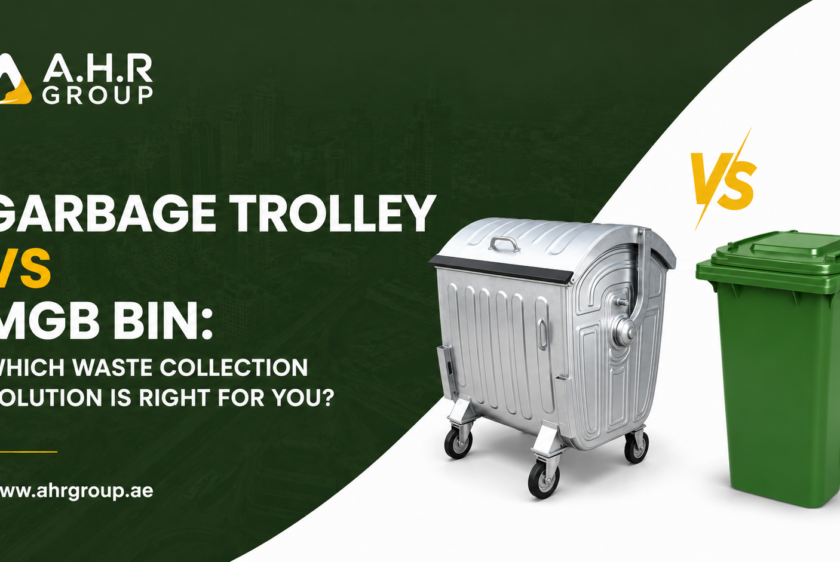
If you manage waste for a commercial site in Dubai, choosing between a garbage trolley and a Mobile Garbage Bin (MGB) can look like a simple call. Both have wheels, both hold waste, both show up in nearly every commercial waste plan. But they’re built for different jobs, and treating them as interchangeable is usually where things go wrong.
Most facilities that get this right don’t pick one over the other — they run both, positioned at different points in the same workflow: trolleys for getting waste out of the building, MGBs for holding it until collection. The real question isn’t which is better. It’s where each one belongs on your site.
Garbage Trolleys: Built to Move
A garbage trolley’s whole job is to travel — through corridors, service lifts, and back-of-house routes, picking up waste along the way.
- Built for daily wear: Made from galvanised steel in sizes from 240L to 1,100L, trolleys are designed to handle the pace of a busy commercial site.
- Less lifting, more wheeling: Staff move a full load in one trip instead of carrying bags floor by floor.
- Where they earn their keep: Hotels, hospitals, shopping malls, and large corporate buildings — anywhere waste must be collected from many points across a large footprint.
MGB Bins: Built to Hold
An MGB works the opposite way. Instead of moving, it stays put — a fixed point where waste sits securely until it’s collected.
- Meets the standard: MGBs are built to EN 840 requirements, in capacities from 120L to 1,100L.
- Keeps waste contained: A close-fitting lid seals in odour and keeps pests out while bins wait for pickup.
- Works for recycling too: Many sites run a separate MGB for paper, plastic, or metal, so recyclables stay clean and unmixed from general waste.
The Real Difference
Strip away the specs, and it comes down to one line: trolleys move waste, MGBs hold it.
Trolleys are the ones doing the rounds, clearing waste floor by floor. MGBs sit in one place — a loading dock, a curbside collection point, or a dedicated bin for a single tenant — waiting for the truck.
Used together, the process is simple: staff clears a floor with a trolley, then tips the load into the MGB waiting downstairs. Nothing gets carried further than it has to, and nothing sits out longer than it should.
Quick Comparison
| Feature | Garbage Trolley | MGB Bin |
| Job | Moves waste internally | Holds waste for collection |
| Capacity | 240L – 1,100L | 120L – 1,100L |
| Material | Galvanised steel | HDPE or steel, EN 840 certified |
| Movement | Constant, throughout the day | Mostly stationary, moved to be emptied |
| Fits best in | Corridors, hotels, hospitals, malls | Loading docks, curbsides, outdoor collection points |
| Main strength | Fast, ergonomic internal handling | Secure, odour-controlled storage |
Sorting Still Matters
Good waste management starts before anything reaches a trolley or a bin. Keeping general waste separate from recycling at the point it’s generated cuts down on contamination and the rework that follows. Colour-coding at both the trolley stage and the MGB stage helps that separation hold up, instead of falling apart the moment staff are rushed.
When a Site Outgrows Trolleys and Bins
Some sites generate more waste than any trolley-and-MGB setup can absorb — large commercial operations, industrial sites, active construction projects.
- Skips: The right call for bulky renovation or industrial debris. Getting the size right matters: too small and you’re paying for extra collections, too big and you’re paying for space you don’t use.
- Chutes: In high-rise buildings, a gravity-fed chute moves waste straight from upper floors to a ground-level collection point, cutting down on lift traffic and manual carrying.
Fewer Vendors, Fewer Headaches
Sourcing trolleys, bins, skips, and chutes from different suppliers adds complexity most facilities teams don’t need. AHR Group supplies the full range — galvanised trolleys, EN 840-certified MGBs, skips, and chute systems — so your equipment is chosen to fit your site, not assembled piecemeal.
The question was never trolley or bin. It’s knowing where each one fits in your waste stream. Get in touch with AHR Group to talk through what your site needs.
Frequently Asked Questions
1. What is the main difference between a garbage trolley and an MGB bin?
A garbage trolley is designed mainly for moving waste, while an MGB bin is primarily used for holding and collecting waste at a designated location.
2. Which is better for hotels, malls and hospitals?
A garbage trolley is ideal for internal waste collection, while MGB bins work well at central collection points.
3. What capacities are available?
AHR garbage trolleys are available from 240L to 1,100L, while MGB bins range from 120L to 1,100L.
4. Can MGB bins be used for recycling?
Yes. MGB bins can be configured for separate recycling streams, helping businesses improve waste segregation.
5. Should I choose a trolley or an MGB bin?
Choose a trolley for frequent waste movement and an MGB bin for storage and collection; many facilities benefit from using both.