Imagine standing in the basement loading dock of a 40-story commercial tower on a Business Day at 8:00 AM on a Sunday. The tenants are arriving, but the waste room is already a war zone. Bins are overflowing onto the epoxy floor, cardboard boxes are stacked against fire exits, and a sour smell is crawling up the service elevator shaft.
Two years ago, someone ordered forty generic 240-litre plastic containers because they were cheap and available. Nobody calculated tenant density, nobody factored in the sheer volume of daily delivery packaging, and nobody set up a dedicated stream for bin waste.
Choosing waste infrastructure isn’t an afterthought—it’s a core operational decision. Get it right, and your loading dock runs like clockwork while lowering your municipal tipping fees. Get it wrong, and you’re fighting fires, failing inspections, and pissing off tenants every week.
The Waste Room Nobody Plans Properly — Until It’s a Problem
Facilities teams routinely spend months picking floor finishes and HVAC filters, then spend five minutes picking waste containers from a catalogue.
That disconnect creates immediate bottlenecks. In Dubai’s high-density commercial spaces, waste streams build up fast. When a building lacks a clear sorting system, every single bag gets dumped together. Mixed bin waste is heavier, messier, and significantly more expensive to collect than sorted streams.
If your maintenance crew spends two hours every morning re-sorting trash or sweeping loose debris off the loading bay floor, your setup has failed. Solving this starts with matching the container to the actual waste stream.
Understanding the Different Types of Commercial Waste Bins
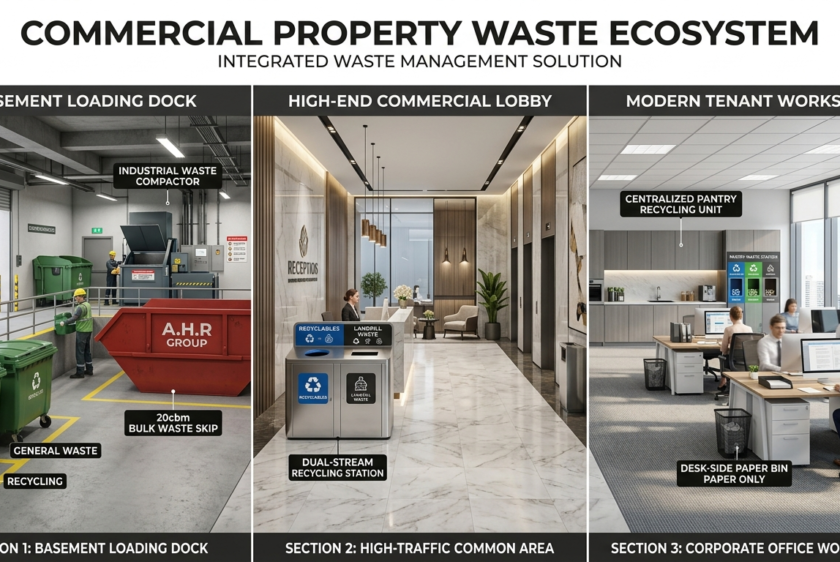
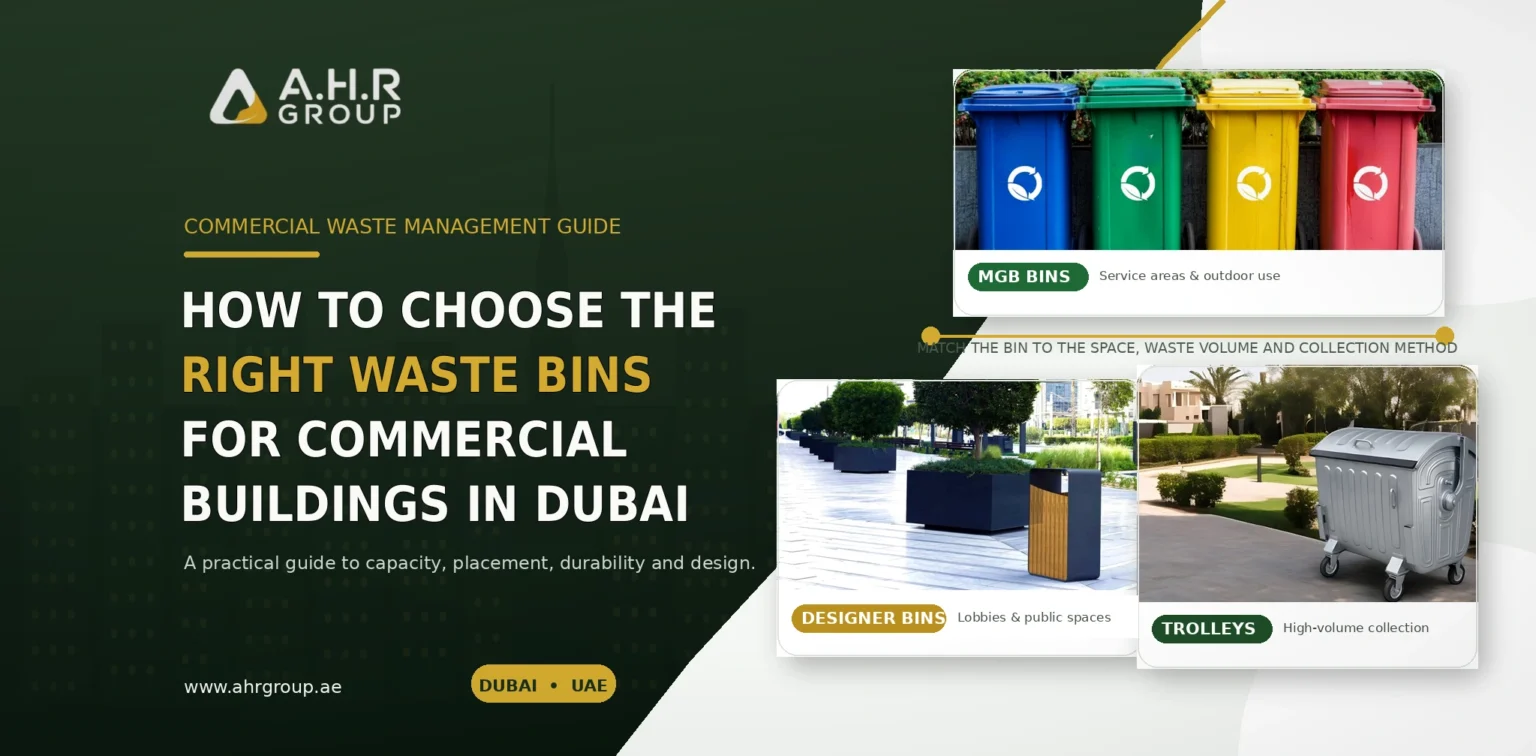
A modern commercial property needs an ecosystem of containers tailored to specific areas and waste types. Throwing a single style of tub in every corner doesn’t work.
General Waste Bins
These handle non-recyclable trash waste and general garbage and waste generated by daily office operations. Built from high-density polyethylene (HDPE) or galvanised steel, these containers need heavy-duty caster wheels and tight-fitting lids to keep odours contained in hot basements.
Dedicated Sorting Stations
To hit sustainability targets and comply with local environmental standards, you need clear, colour-coded collection points:
- Recycle bin units: Standardised containers for dry recyclables like paper, clean cardboard, and aluminium cans.
- Trash and recycling bin combos: Integrated multi-compartment units designed for lobbies, lift banks, and food courts.
- Garbage recycle bin stations: High-visibility public units that encourage tenants to separate waste at the point of disposal.
Using a proper recycle trash bin setup prevents cross-contamination. Once organic food waste touches clean paper, that entire batch of paper loses its recycling value and gets redirected to a landfill.
Sizing Your Bins Correctly — The Mistake Almost Every Building Makes
Buying a big bin for every floor seems like a safe bet, but oversized containers sit half-empty, taking up prime real estate and encouraging stagnant, odour-causing waste. Conversely, undersized units overflow within hours. Getting the volume right depends entirely on your building’s footprint and operational flow:
- High-Rise Office Towers (20+ Floors): Require 1100L HDPE Wheelie Bins paired with a central compactor. The focus here is managing massive daily volume and ensuring compatibility with standard mechanical truck tippers.
- Mid-Rise & Mixed-Use Commercial Spaces: Work best with 240L to 660L Mobile Bins backed by an external skip. Smaller dimensions allow custodial staff to maneuver containers through tight service lifts and narrow basement corridors easily.
- Retail Centres & Food Courts: Need heavy-duty skid bin setups alongside dedicated bio-waste containers. The main priority here is leak-proof containment to handle high-density, organic food waste without mess or pest risks.
When planning logistics, consider how your custodial staff moves waste from office pantries to the basement. A heavy-duty skid bin or towable wheelie bin allows teams to hook multiple containers together, moving large volumes through service corridors in a single trip rather than making dozens of manual runs.
Garbage Skips — When Your Building Needs More Than Standard Bins
Standard wheelie bins hit their limit quickly during tenant fit-outs, deep cleaning cycles, or major building maintenance. That’s when you need heavy-capacity steel containers.
┌─────────────────────────────────────────────────────────────────────────────┐
│ 20cbm ROLL-ON/ROLL-OFF SKIP
│ Dimensions: ~6.1m (L) x 2.4m (W) x 1.6m (H)
│ Ideal For: Commercial fit-outs, bulky packaging, construction debris
└─────────────────────────────────────────────────────────────────────────────┘
A 20cbm (cubic meter) roll-on/roll-off skip serves as a reliable backbone for large commercial complexes. It handles bulky timber, discarded office furniture, and massive volumes of collapsed corrugated cardboard.
Partnering with an established garbage skip supplier in Dubai ensures you get quick swap-outs when containers hit capacity. A full garbage skip sitting on your loading ramp blocks delivery trucks and creates immediate operational gridlock.
Specialised Waste Streams — Bins Most Buildings Forget About
Compliance issues rarely stem from general trash; they happen when hazardous or regulated waste gets thrown into standard streams. Failing to separate specialised waste streams leads to heavy regulatory fines and serious safety hazards on site:
- Chemical Waste Bin: Mandatory for facilities with maintenance workshops, central cooling plant rooms, or printing labs. A specialised chemical waste bin requires chemical-resistant lining (such as fluorinated HDPE) and secure locking mechanisms to safely contain oils, solvents, and cleaning chemicals without toxic fumes or leaks.
- Battery Recycling Box: Essential for modern office towers. E-waste regulations require isolated collection points to prevent lithium-ion battery fires inside collection trucks and stop heavy metals from leaching into general waste streams. Placing a clear battery recycling box in central lobbies or IT hubs makes compliant disposal effortless for tenants.
- Biodegradable Trash Can: Specialised compostable or bio-lined bins designed specifically for building cafeterias, break rooms, and food preparation spaces. Using a dedicated biodegradable trash can isolates wet organic waste before it decomposes, eliminating pest risks and foul odours in service corridors.
Smart Bins — The Technology Layer Most Dubai Buildings Are Missing
Leading commercial properties in the UAE are shifting from fixed collection schedules to data-driven operations using smart bin technology. The workflow is simple but transformative: ultrasonic fill sensors mounted inside the waste containers monitor volume in real-time, transmitting this data over a wireless network directly to your centralised facilities dashboard.
Instead of cleaning crews checking empty bins every two hours, the system generates automated, location-specific alerts—notifying the dispatch team only when a specific basement container hits 80% or 85% capacity. This targeted approach eliminates wasted labour, completely stops unexpected overflows, and provides hard data on your building’s seasonal waste spikes rather than relying on guesswork.
Beyond Bins — When Compaction and Recycling Machines Make Sense
If your building generates massive daily waste volumes, relying solely on static bins means you’re paying to haul air. When loose cardboard and plastic film are thrown into a standard container, they quickly bridge across the top and consume 100% of the bin volume, often requiring six to eight skip pickups a week to manage.
Integrating commercial recycling machines—such as a vertical waste baler or an ECOBIN compactor—radically alters waste room logistics. By compressing loose materials into dense, stackable bales directly inside the waste room, you reduce the total waste footprint to just 15% of its original size. That 85% volume reduction translates directly to freeing up prime floor space, needing fewer containers, and cutting your costly skip haulage trips down to just one or two per week.
Choosing the Right Garbage Bin Supplier in Dubai
This is where most buildings get it wrong, because price becomes the only filter. A genuine garbage bin supplier in the UAE — as opposed to a reseller with one product line — should offer:
✅ A real range across general, recycling, and specialised waste bin brands
✅ Sizing based on your specific building, not a one-size-fits-all catalogue
✅ After-sales support — replacement wheels, lids, and lock mechanisms
✅ Experience across different bin companies and building types
✅ Local UAE delivery and installation, not a supplier operating from overseas
Choosing between waste bin suppliers in Dubai on price alone among competing bin brands almost always costs more later — in replacement parts, in downtime, and in bins that were never sized correctly to begin with.
Who Handles Collection — And Why That Relationship Matters Too
Your hardware is only as good as the service that empties it. The collection crew—or “bin man”—needs clear, unblocked access to your loading docks on a predictable schedule.
High-rise buildings require clear staging zones. Bins must move smoothly from service lifts to collection points without damaging wall finishes or creating noise disruptions for ground-floor retail tenants during early morning pickups.
How A.H.R Group Helps Dubai Buildings Get This Right
At A.H.R Group, we don’t just dump a catalogue on your desk. We help facilities managers design complete, compliant waste ecosystems tailored to their property’s specific footprint and tenant profile.
Our commercial range includes:
- Heavy-duty wheelie containers and indoor multi-stream sorting units
- High-capacity steel containers available via our dedicated garbage skip supply
- Certified indoor and outdoor recycle bin setups
- Advanced hazardous containment like a dedicated chemical waste bin
- High-efficiency volume reduction through recycling machines like the ECOBIN baler
Frequently Asked Questions
1. What size garbage skip does a commercial building in Dubai typically need?
Most mid-to-large commercial properties rely on a 20cbm roll-on/roll-off skip for general bulky waste and packaging, supplemented by 660L or 1100L wheelie bins for daily office trash.
2. Do I need separate chemical waste bin containers if my building has no industrial tenants?
Yes. Facilities maintenance teams handle paints, fluorescent tubes, solvents, and heavy cleaning agents. These materials require dedicated chemical containment under local environmental guidelines.
3. How do I choose between different bin brands for a large commercial property?
Prioritise international safety certifications (such as EN 840 for mobile waste containers), UV-stabilized materials suited to the Middle East climate, and local spare parts availability for wheels and lids.
4. Are smart bins worth the investment for mid-sized Dubai buildings?
Yes. Sensor-based smart bins cut down on unnecessary labour trips by alerting your staff only when containers are ready for emptying, preventing both overflow and wasted collection runs.
5. Can A.H.R Group supply both bins and waste compaction equipment together?
Absolutely. A.H.R Group provides end-to-end setups, ranging from lobby sorting bins to industrial-grade skips and ECOBIN waste compactors.